


Lot n° 99
Estimation :
8000 - 12000
EUR
Result without fees
Result
: 12 000EUR
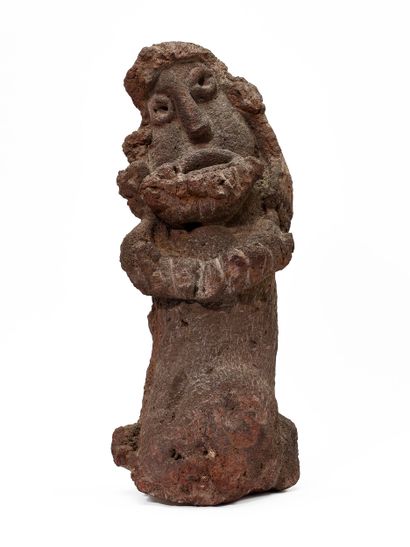
"The dreaming bearded man - Lot 99
"The dreaming bearded man
SCULPTURE from the "Barbus Müller" series
Attributed to Antoine Rabany (1844-1919)
Volcanic stone
H. 64 cm
Biography l The term "Barbus-Müller" was coined by Jean Dubuffet and published in the first fascicule of l'Art Brut in 1947 to designate a series of sculptures made from volcanic lava. In 1939, the first ten sculptures appeared on the Paris flea market, seven of which were acquired by Geneva collector Josef Müller. Other pieces emerged in 1945. Dubuffet included three pieces in the collections of the Compagnie de l'Art Brut in 1951. The pseudonym he defined refers both to the physiognomy of the figures, most of which have beards, and to the surname of the collector who first acquired them.
We would like to thank Bruno Montpied for his authentication and text.
This is the 66th "Barbu Müller" to appear in my inventory, according to a recent communication from Azur Auctions. It's one of a series of initially anonymous sculptures, of popular origin, named "Barbus Müller" by Jean Dubuffet in 1946, which I've inventoried on the basis of sales, catalogs, collections, exhibitions, a house, a town hall, the Internet, or even seen in the hands of an antique dealer. I've been collecting images of these sculptures for several years now. The painter and writer Dubuffet, when he was inventing the notion of Art Brut in the post-war years, came across some of them of unknown pedigree. They served as a kind of foundation stone for his nascent collection, destined in the following decades to take on legendary status in art history. Since Azur enchères asked me what I thought of the "Barbu" opposite, I've added five new ones to my inventory, based on photos recently (summer 2025) revealed by Pauline Goutain in the exhibition she mounted at the Musée Roger Quillot, in Clermont-Ferrand, "L'Auvergne de la modernité". This brings me to 71 cases of "Barbus Müller".
It seems obvious that they come from a volcanic region, given the material from which they were generally carved. The Auvergne was the obvious birthplace, rather than the exotic country with which some thought they were sometimes associated. And, in fact, between 2017 and 2020, various searches enabled me to establish, with photographic evidence, that several of these "Barbus Müller" actually came from a peasant, ex-soldier, Antoine Rabany (1844-1919) who had lived in the village of Chambon-sur-Lac, in the Puy-de-Dôme, near Murol and Saint-Nectaire. Few biographical details about this sculptor - a self-taught man, not an artist in the professional sense of the term - have been collected to date.
But let's clear up a misunderstanding. The "Barbus Müller" were not all assembled by Dubuffet alone. The corpus was built up little by little, starting with sixteen sculptures whose photographs were the subject of a 1947 fascicle published by Gallimard at the painter's request (not distributed, but reissued in 1979 and again in 2020). Subsequently, a number of other pieces were added, all of which were stylistically similar to the sixteen, and shared a common volcanic material. This was done by a variety of experts and connoisseurs, collectors, exhibition curators, museum curators and artists. On the whole, they were brought together without any rigorous traceability back to the Chambon peasant.
As a result, some of the 71 pieces in my inventory may well have been very similar to the first sculptures by Rabany, but not created by him, but rather by another self-taught artist with a very similar style. The works certain to come from Rabany alone, which I have classified in a separate inventory, currently number around twenty, to which may be added five sculptures currently unlocated but which appear in photos taken in 1908 (found by Pauline Goutain).
The sculpture of the "Dreamer" (a title invented by me) for this sale is not one of the twenty or so sculptures officially attributed to Antoine Rabany. It can only be attributed to him, on the assumption that he is indeed the author of all known "Barbus Müller". This "Barbu" appears analogous to two others in Dubuffet's photographic documentation, with which it shares stylistic characteristics.
Further text available on request
Bruno Montpied, August 2025.
My orders
Sale information
Sales conditions
Return to catalogue