


Lot n° 69
Estimation :
6000 - 8000
EUR
Result without fees
Result
: 94 000EUR
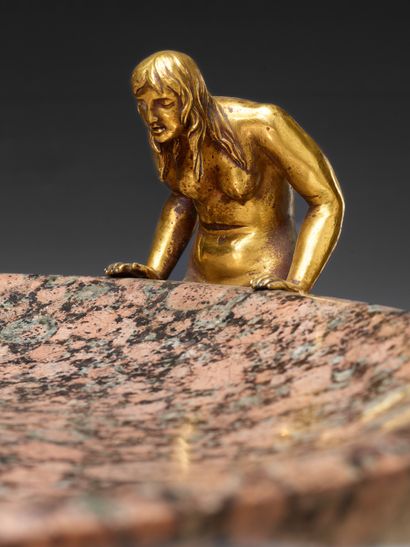
IMPORTANT AND RARE "TAZZA" CUP in pink Rapakivi granite from - Lot 69
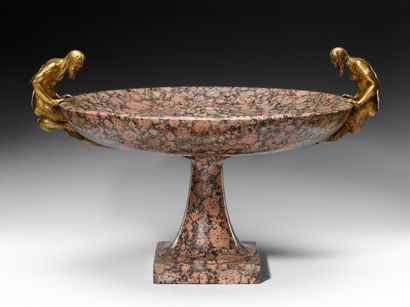
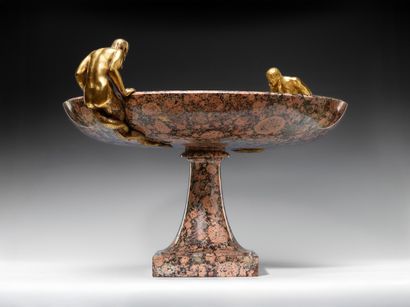
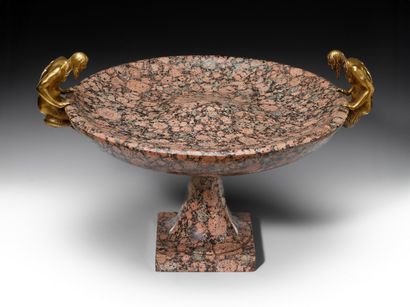
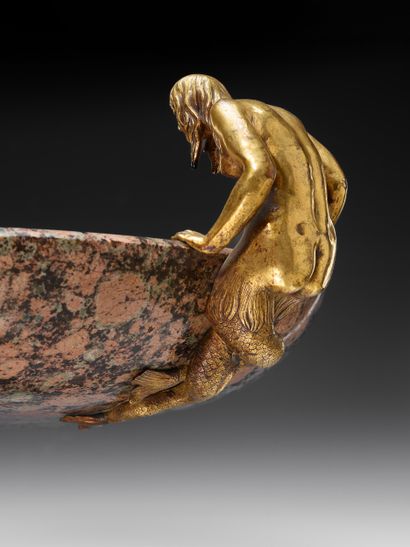
IMPORTANT AND RARE "TAZZA" CUP in pink Rapakivi granite from Finland, of circular form resting on a pedestal with square base, mounted in chased gilt bronze decorated with two mermaids forming handles. Russia, probably Saint Petersburg, circa 1800.
The sculpture is attributed to the Imperial Lapidary Manufactory of Péterhof.
The bronzes are attributed to the Imperial Bronze Foundry of St. Petersburg.
H. 38 cm (51 cm with mermaids)
64 cm in diameter
(one mermaid refixed, small chips and missing parts on the corners of the base, chips on the edges, wear to the patina of the bronzes)
ALSO INCLUDED is a quadrangular wooden base painted to imitate marble.
54 x 45 x 47.5 cm (wear)
Related works: Several hardstone vases and bowls mounted in gilt bronze in Russia around 1800, with handles in the shape of mermaids and tritons, sometimes with Egyptian heads, are known; let us cite a few rare examples:
- Stroganoff covered vase, in pink Ural granite and gilt bronze with Egyptian mermaid motifs, h. 56 cm, c. 1805 (Galerie Steinitz, Paris).
- Vase in grey porphyry from Yekaterinburg, mounted in gilt bronze by Pierre-Marie-Louis Agis with winged mermaid motifs, h. 106 cm, 1804 (Hermitage Museum, St. Petersburg, 2674).
- A white quartz vase from Yekaterinburg, mounted in ormolu by Pierre-Marie-Louis Agis with winged mermaid motifs.
of winged mermaids, h. 113 cm, 1802 (Hermitage Museum, St. Petersburg).
- Red breccia vase from Yekaterinburg, mounted in ormolu with Egyptian triton motifs, h. 59.2 cm, c. 1801 (Hermitage Museum, St. Petersburg, 2689).
- Oval malachite bowl mounted in gilt bronze with winged tritons, h. 17 x d. 24.5 cm, c.1830 (Hermitage Museum, St. Petersburg, 1034).
- Similar mermaid motifs can be found on a pair of bronze vases in the entrance hall of the Zoubov Foundation in Geneva.
History l Rapakivi granites have been used in Finland since the Middle Ages, but their most spectacular use is undoubtedly in the monuments built in St. Petersburg between 1760 and 1917. Notable examples include the majestic, slender Alexander Column (1834) on Palace Square, and the 112 columns of St. Isaac's Cathedral (1828), each built from the same red granite. Our pinkish-brown granite on a black background is similar to the majestic columns of the interior of Kazan's Cathedral of Our Lady (1811). These different-colored granites come from the Vyborg batholith (St. Petersburg oblast), in several quarries around the municipality of Virolahti, in southeastern Finland (former territory of Imperial Russia). Today, the 1640-million-year-old Vyborg batholith is the main production area for natural stone in Finland and the St. Petersburg region. The main Rapakivi granite varieties quarried are Baltic Brown, Baltic Green, Carmen Red, Karelia Red, Eagle Red and Balmoral Red, which are still produced in large quantities in Finland for the world stone market due to their unique qualities.
Expert l Maxime Charron
My orders
Sale information
Sales conditions
Return to catalogue