


Lot n° 68
Estimation :
4000 - 6000
EUR
JALISCO - Mexico 100 BC. J.-C. - 250 AD. J.-C. - Lot 68
JALISCO - Mexico 100 BC. J.-C. - 250 AD. J.-C.
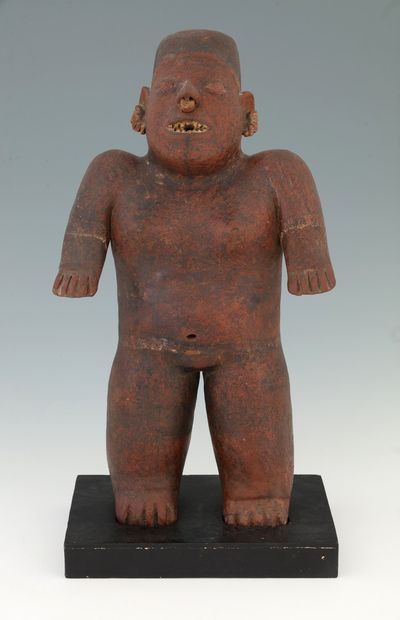
Hollow beige-gray terracotta with brick-red slip. Important traces of manganese oxide and presence of burial residues
H: 56 cm Width: 26 cm
Provenance l Former collection of the Galerie Le Corneur Roudillon (1923-2020)
Expert l Mermoz Gallery
This terracotta sculpture, of a particularly important size and in a good state of conservation, is an emblematic work of Jalisco art; a valuable offering, with a funerary vocation, made by a master potter in homage to an eminent member of a clan, probably buried near the latter, in a deep well tomb typical of Western Mexico.
The traditions of this region of Mexico, located in an arc that spans the present-day states of Colima, Jalisco and Nayarit, form an archaeological complex that stands out for the quality and diversity of its ceramics, sublimated by a beautiful brick-red slip, numerous polychrome decorations and careful polishing. The human figures constitute an important corpus, which reveals a concern to represent the men and women of the time in their daily life as well as in their ritual life.
Standing on his two short and sturdy legs, in a frontal position, this figure displays his authority and power. The body is massive with a particularly wide bust and a slightly rounded belly. The chest is discreet but it is undeniably a woman. The shoulders are round and raised. They are prolonged by very short arms, ending in cubic and schematic hands, whose palms are open towards the front. A posture that suggests participation in a ceremony and a moment of invocation and intense prayer.
The head is slightly raised towards the sky. Its shape, flattened and elongated, with a high and receding forehead, indicates a ritual deformation of the skull. His numerous finery, modeled or painted, such as his two narigueras, his imposing ear ornaments, the bracelets that can be seen on his arms, confirm his status as a dignitary. The short and pointed nose is strongly projected forward. The oval eyes are open, as well as the mouth whose teeth are visible. The skull is covered with brown-black paint to represent the hair that runs straight down the back of the neck. The back is flat and the waist is low. The buttocks are rounded and the legs are spread. The navel is pierced and underneath is a thin strip of light color that serves as a belt. The darker flat areas of paint on the thighs suggest the wearing of "shorts". The scattered black traces that cover this work are the result of the oxidation of the terracotta and the proof of its prolonged burial.
My orders
Sale information
Sales conditions
Return to catalogue